

Between What Was and What's Next
Friday links...No101

This week’s links are about life in liminal times. The first half is stark but that’s the current reality of things. Then come a few links with more light in them in direct response to these disorientating in between days. As a quote from one of the books below puts it: “Thinking positively about our future is not a naive individual pursuit but a powerful shared duty; it’s the ability to see the world for what it is and press on anyway.”
1. Starting here: last week, a simple yet highly consequential post came from Anthropic’s CEO. Even if this is not your sort of thing, take a minute to read the brief headlines below. Four simple bullet points, all interconnected. In practice, this means the creation of unknown numbers of artificial entities each with agency, globally accessible to good and bad actors, with the potential to reshape every political and socio-economic system on the planet - for better and worse - at a scale never before seen.
Most of this we already know, right? The new news is that this is all coming at us far faster than we ever thought possible, with mirrored announcements also coming from Sam Altman, his peers and their counterparts in China.

We read these sort of announcements with increasing regularity…but are they really sinking in? As Max Tegmark, leading AI academic and author of ‘Life 3.0: Being Human in the Age of Artificial Intelligence’, replied to the above post: “Most of my MIT colleagues are in denial of this coming tsunami.”
Make that all of us. Listening to the more objective experts and elders like Tegmark, Geoffrey Hinton and many others, it’s hard not to feel like we’re now in the eerie drawback stage, pre-tsunami:

[Side note: for those interested in the jaw-dropping emerging reasoning capabilities of the latest AI models, Azeem Azhar wrote a great piece this week called The Age of Reason(ing models) that clearly signposts “the economic earthquake waiting to happen.”]
2. I’m reminded of a piece written by Clay Shirky in 2008 called Thinking the Unthinkable. Whilst at that time the piece focused on the impact of the Internet on newspapers, it was a specific writer and her book he referenced that’s remained with me over the years and seems even more pertinent today: Elizabeth Eisenstein’s, The Printing Press as an Agent of Change.

As Shirky explains, “What Eisenstein focused on was how many historians ignored the transition from one era to the other. To describe the world before or after the spread of print was child's play; those dates were safely distanced from upheaval. But what was happening in 1500? The hard question Eisenstein's book asks is "How did we get from the world before the printing press to the world after it? What was the revolution itself like?"
“Chaotic, as it turns out. As novelty spread, old institutions seemed exhausted while new ones seemed untrustworthy; as a result, people almost literally didn't know what to think. That is what real revolutions are like. The old stuff gets broken faster than the new stuff is put in its place.
The importance of any given experiment isn't apparent at the moment it appears; big changes stall, small changes spread. Even the revolutionaries can't predict what will happen. Agreements on all sides that core institutions must be protected are rendered meaningless by the very people doing the agreeing. Ancient social bargains, once disrupted, can neither be mended nor quickly replaced, since any such bargain takes decades to solidify.”
And so it is today.
3. And, if we’re experiencing the rapidly emerging reality of the oncoming AGI tsunami, simultaneously we’re also experiencing unprecedented, almost daily geo-political cyclones of reordering events unfolding in the real world, in real time. I try to steer clear of politics in these posts, but I read this quote which seems fitting for these times. Written by Italian political activist Antonio Gramsci in one of his letter’s from Mussolini’s jails: “The old world is dying, and the new one struggles to be born; now is the time of monsters.”
3. As I wrote about at the beginning of the year, I’m a self-confessed, struggling optimist. So, when a new book called The Bright Side: Why Optimists Have the Power to Change the World was recommended a few weeks ago, my immediate reaction was: do we really need another book like this? Aren’t these times calling for something, er, a bit different? But the stark opening line of this book sets up what is a truly compelling read:
“I became an optimist the night my wife died.”
4. The Bright Side is written by Sumit Paul-Choudhury former editor of the New Scientist. “What initially feels like it might be a self-help book turns into an eye-opening history of the idea of optimism, before exploring its potential to help us address social and ecological challenges. The tension in our relationship to optimism, between its motivating and its delusional possibilities, is present throughout.” Full review here.

5. On the back of reading the book, a few of us are going to this: A Night of Unbridled Optimism. Sumit Paul-Choudhury is joined by ‘reluctant futurist’ Mark Stevenson. I’ve seen Mark Stevenson talk a few times before and, probably like many, listened to his great Futurenauts podcast with John Richardson and Ed Gillespie. He’s both deeply serious and deeply funny. So this should be an inspiring, timely conversation. Tuesday, 1st April, Earl of Derby, SE14 5LW. Tickets here.

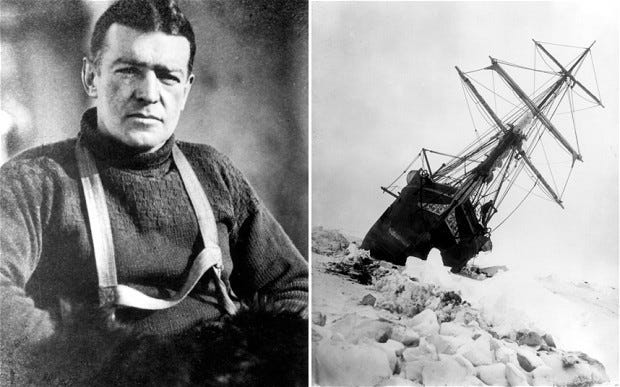
6. As serendipity would have it, we also recently met with Martin Brooks, founder of the Shackleton brand and Shackleton Challenges (Paul Choudhury also references Shackleton in his book). We talked about the challenges of leadership in these liminal times. In that conversation, Martin reminded us of Shackleton’s very practical, very persistent modus operandi and his most famous quote:
“The quality I look for most is optimism: especially optimism in the face of reverses and apparent defeat. Optimism is true moral courage.”
As Paul-Choudhury says: “We all have reckonings with life and death sooner or later. It’s at such times that optimism can be hardest to secure, but also most valuable. Optimism, far from leading us to passively await our fates, can help us to explore our limitations - and transcend them.”
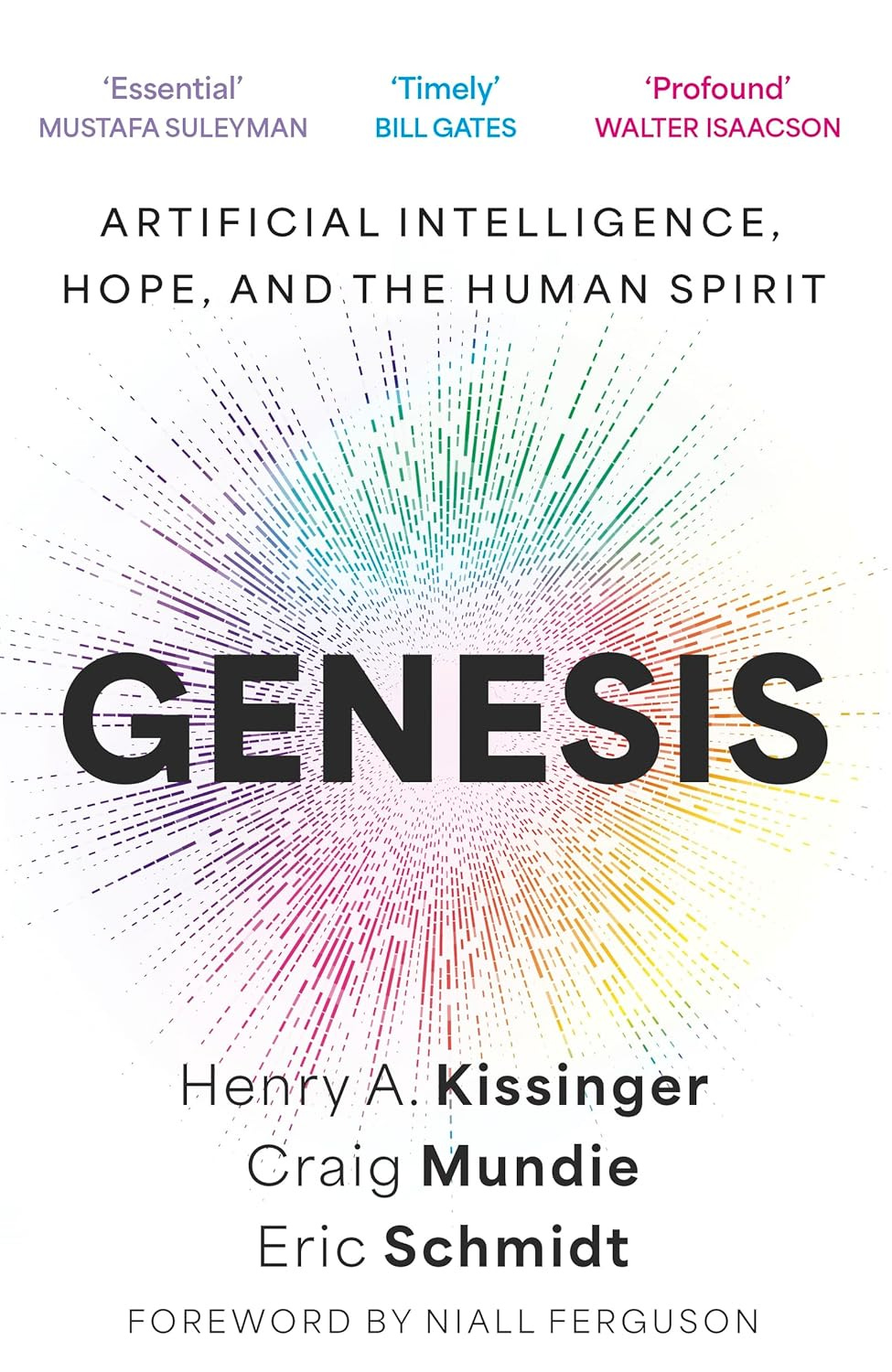
7. Which brings me to another, recently released book that acts as both a guide and a warning: Genesis: AI, Hope and the Human Spirit. If you’re looking for a deeper, balanced perspective on where we’re heading…this is a great read.
“The authors go beyond the technical potential of AI to focus on the biggest existential questions facing humanity, from how our perception of reality will change to how our knowledge discovery processes are evolving.
The book aims to present an effective roadmap for the AI era over three main sections that address humanity’s discovery adventure, the effects of AI on politics, security, economy and science, and strategies for the future. The authors emphasise AI’s potential to solve major crises, from climate change to income inequality, while also highlighting challenges that could threaten human free will and decision-making. A masterful blend of history, technology and philosophy, Genesis convinces the reader that we are witnessing not only a technological revolution, but also a new stage in the evolution of the human spirit.” Review here.
8. With everything going on, if that’s too much, this interview with Eric Schmidt, ex-Google CEO, provides a helpful overview to the key themes covered in his book and the new world ahead of us.
9. Finally, for those looking for a more philosophical exposition on Hope, in early January I wrote briefly about a powerful new book by Byung-Chul Han called The Spirit of Hope.

“Hope builds a bridge across the abyss into which reason cannot look. It can hear an undertone to which reason is deaf. To the hopeful, the world appears in a different light. Hope gives the world a special radiance; it brightens the world.”
10. Leaving it here this week with a short extract from a recent Nick Cave post:
“So, what is hope, and what is hope for? Hope is an emotional temper that emboldens the heart to be active, it is a condition, a mood, an aura of being. It is a feat of the imagination, both courageous and ingenious, a vitality that inspires us to take innovative action to defend the world. Hope is essential to our survival and our flourishing.
…Hope is optimism with a broken heart. It has an earned understanding of the sorrowful or corrupted nature of things, yet it rises to attend to the world even still. In its active form, hope is a supreme gesture of love, a radical and audacious duty. Hope becomes the energy of change.”
Have a great weekend, Matt
Quote of the week: “There may be tyrants and murderers, and for a time, they can seem invincible. But in the end, they always fall. Think of it: always.” Mahatma Gandhi